
 EN
 FR
 中文
 ES
 PT
 عربي
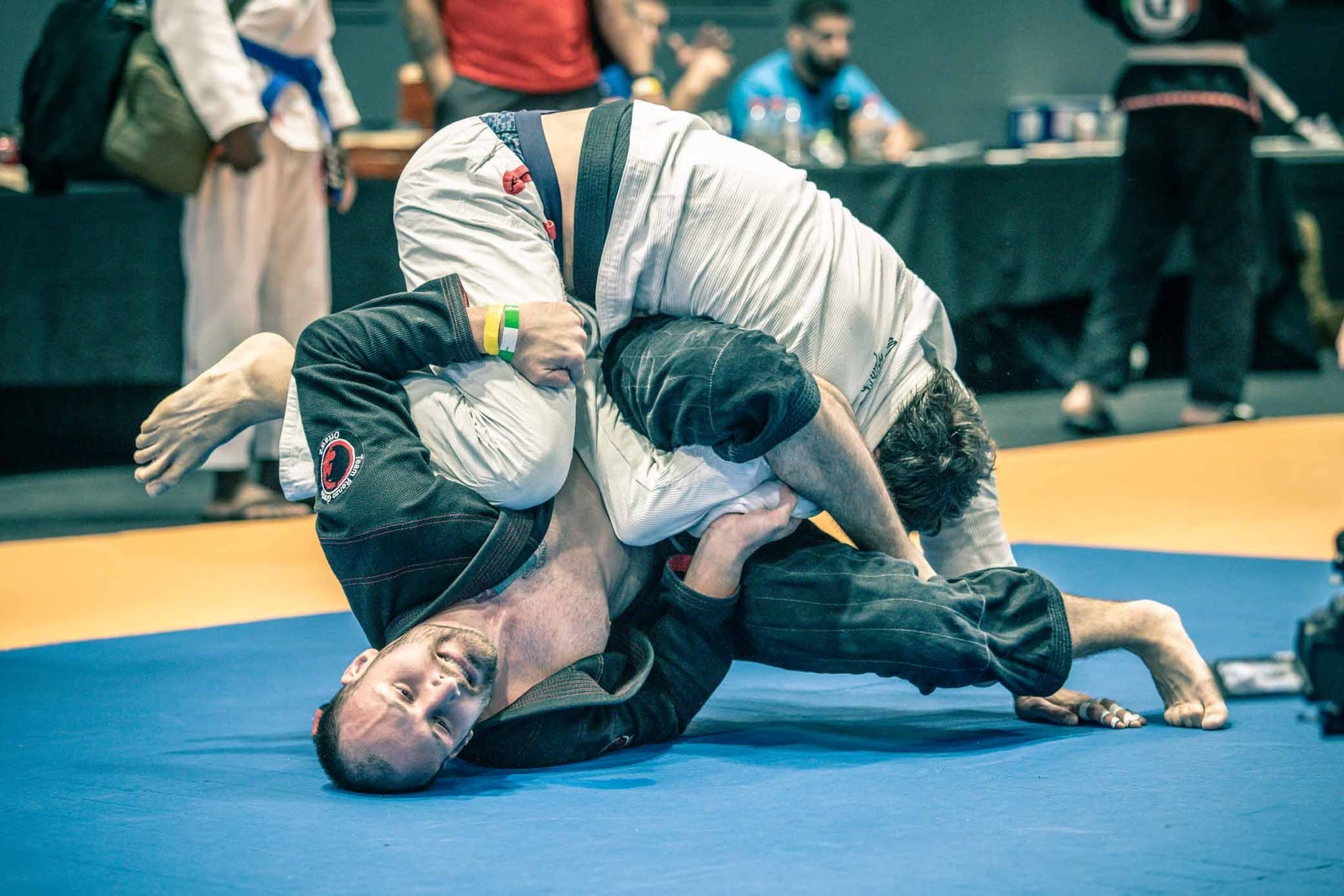
What Does Your First BJJ Tournament Feel Like?
You've been training for months. You feel decent on the mats at your home gym. Then someone mentions a tournament and your stomach drops. Sound familiar?
Every single person who has ever competed in BJJ felt exactly this way before their first event. The black belt coaches, the world champions, the guy who has 50 matches under his belt - they all had a first time, and they all felt the same mix of excitement and dread.
Here's what nobody tells you: the hardest part of your first competition isn't the match. It's the waiting. You'll arrive at the venue, warm up, and then sit around for what feels like an eternity until your bracket is called. Your adrenaline will spike and crash multiple times before you even step on the mat.
Once the match starts, something shifts. Training takes over. You might not execute your game plan perfectly - almost nobody does in their first competition - but your body knows more than your anxious brain is giving it credit for. The 5 or 6 minutes will fly by faster than any round you've ever rolled in class.
Win or lose, when it's over, you'll feel something you can't get any other way: the knowledge that you did something genuinely difficult, voluntarily, and survived.
How Do Adult BJJ Competitions Work?
Adult BJJ competitions are organized around three variables: belt rank, weight class, and age division. This triple-layer system ensures you face opponents as similar to you as possible.
Format options:
- Gi - traditional uniform, grips on lapels and sleeves are legal
- No-Gi - rash guard and shorts (men wear board shorts, with compression shorts allowed underneath; women may also wear spats), no fabric grips allowed
Most tournaments offer both, and you can register for one or both. They're treated as separate divisions with separate brackets.
Match structure:
- Match length depends on your age division and belt. Adult division: white 5 minutes, blue 6, purple 7, brown 8, black 10. Master 1: 5 minutes for white and blue, 6 for purple, brown and black. Master 2 to Master 7, and Juvenile: 5 minutes.
- Points are scored for positional advancement, held for 3 seconds: takedown (2 pts), sweep (2 pts), knee on belly (2 pts), guard pass (3 pts), mount (4 pts), back control (4 pts)
- Advantages break ties when points are equal - these are awarded for near-submissions and close positional attempts
- A match can end early by submission (tap), referee stoppage or disqualification
- At IBJJF events, only coaches with a valid IBJJF black belt membership may coach from the mat-side coaching area; if there is no coaching area, your coach calls from outside the barrier
Bracket format:
- Single elimination is most common at IBJJF events
- If there are only 2-3 people in your bracket, IBJJF uses a modified single-elimination format (not round-robin)
- The open class (absolute) is only for athletes who finished 1st to 3rd in their weight division (all Adult black belts may enter), and gi events have no open class for white belts
What Are the IBJJF Adult Divisions?
The IBJJF places you by birth year: subtract your birth year from the competition year. There is no upper age limit, so a Master can also choose a younger Master division or the Adult division. The age categories are:
Age divisions (2026)
| Division | Age in 2026 | Born in |
|---|---|---|
| Juvenile 1 | 16 | 2010 |
| Juvenile 2 | 17 | 2009 |
| Adult | 18-29 | 1997-2008 |
| Master 1 | 30-35 | 1991-1996 |
| Master 2 | 36-40 | 1986-1990 |
| Master 3 | 41-45 | 1981-1985 |
| Master 4 | 46-50 | 1976-1980 |
| Master 5 | 51-55 | 1971-1975 |
| Master 6 | 56-60 | 1966-1970 |
| Master 7 | 61+ | 1965 or earlier |
Age = 2026 minus your birth year. The birth years move up by one every January.
This matters. A 42-year-old white belt doesn't have to compete against a 22-year-old college athlete. The Master divisions exist specifically so you face people at a similar stage of life. Many competitors find their groove in the Master divisions, where the atmosphere is competitive but the participants tend to be more measured and experienced in managing their bodies.
Belts and match length
| Belt | Minimum age | Adult | Master 1 | Master 2-7 |
|---|---|---|---|---|
| White | Any age | 5 | 5 | 5 |
| Blue | 16 | 6 | 5 | 5 |
| Purple | 16 | 7 | 6 | 5 |
| Brown | 18 | 8 | 6 | 5 |
| Black | 19* | 10 | 6 | 5 |
* 18 only for an athlete who won the Adult World Championship at brown belt. Juveniles (16 and 17) compete at white, blue or purple belt, and their matches last 5 minutes.
For men, weight classes range from rooster (57.5 kg / 127 lbs or less, weighed in the gi) to ultra heavy (over 100.5 kg / 222 lbs). Men have 9 weight classes and women have 8, plus an open class, with roughly 5 to 6.5 kg between classes.
Weight classes (gi)
Maximum weight at IBJJF gi events, weighed in your gi, once, right before your first match. No-gi events use a different list, so check the event page.
| Weight class | Men | Women |
|---|---|---|
| Rooster | 57.5 kg127 lb | 48.5 kg107 lb |
| Light Feather | 64 kg141.6 lb | 53.5 kg118 lb |
| Feather | 70 kg154.6 lb | 58.5 kg129 lb |
| Light | 76 kg168 lb | 64 kg141.6 lb |
| Middle | 82.3 kg181.6 lb | 69 kg152.6 lb |
| Medium Heavy | 88.3 kg195 lb | 74 kg163.6 lb |
| Heavy | 94.3 kg208 lb | 79.3 kg175 lb |
| Super Heavy | 100.5 kg222 lb | No limit |
| Ultra Heavy | No limit | — |
| Open class | No limit | No limit |
| Weight class | Boys | Girls |
|---|---|---|
| Rooster | 53.5 kg118 lb | 44.3 kg98 lb |
| Light Feather | 58.5 kg129 lb | 48.3 kg106.6 lb |
| Feather | 64 kg141.6 lb | 52.5 kg116 lb |
| Light | 69 kg152.6 lb | 56.5 kg125 lb |
| Middle | 74 kg163.6 lb | 60.5 kg133.6 lb |
| Medium Heavy | 79.3 kg175 lb | 65 kg143.6 lb |
| Heavy | 84.3 kg186 lb | 69 kg152 lb |
| Super Heavy | 89.3 kg197 lb | No limit |
| Ultra Heavy | No limit | — |
| Open class | See the event | See the event |
What Techniques Are Legal at Each Belt?
One of the smartest things about IBJJF rules is the progressive unlocking of techniques as you advance in belt rank. This protects less experienced competitors from dangerous submissions they might not recognize in time.
White Belt restrictions:
- No heel hooks (inside or outside)
- No knee reaping
- No toe holds
- No wrist locks, kneebars, calf slicers or bicep slicers
- No cervical neck cranks (illegal at every belt)
- No slams (illegal at every belt)
- No scissor takedowns (illegal at every belt)
Blue Belt adds:
- Wrist locks become legal
- Straight ankle locks remain legal (as they are for all belts)
Purple Belt adds:
- No additional leg lock submissions beyond straight ankle lock
Brown and Black Belt adds:
- Kneebars become legal
- Toe holds become legal (applying outward pressure on the foot stays illegal)
- Calf slicers and bicep slicers become legal
- Knee reaping becomes legal only for brown and black belts in the Adult division at no-gi events; it stays illegal in Master divisions and in the gi
Important note: heel hooks are illegal in IBJJF gi competition at every belt. In no-gi they are legal only for brown and black belts in the Adult division, not in Master divisions.
If you're competing for the first time as a white belt, your focus should be on takedowns, guard passing, achieving dominant positions, and basic submissions - armbar, triangle, rear-naked choke, kimura, americana, and guillotine. Two more white belt rules: jumping into closed guard on a standing opponent is penalized, and if you have a judo black belt, any MMA record, or wrestling experience at college or national level, IBJJF will not let you compete as a white belt.
How Should I Prepare?
A solid competition preparation timeline looks like this:
6-8 Weeks Out
- Tell Coach Louis-Philippe you want to compete. This is step one. The coaching team will help you identify your A-game and structure your training around it.
- Register for the tournament. Pick your division, pay the fee, and commit. Having money on the line makes it real.
- Increase training frequency to 4-5 sessions per week if possible. This isn't about overtraining - it's about building the cardio base and repetition count you'll need.
4-6 Weeks Out
- Drill your A-game relentlessly. Pick 2-3 takedowns, 2 guard passes, 2 sweeps, and 2-3 submissions. These should be your highest-percentage techniques - the moves you hit most often in rolling.
- Start doing competition-style rounds - 5-minute rounds from standing with full resistance. This is different from your regular rolling and will expose cardio gaps early.
- Study the rules. Know what scores points, what's illegal, and what advantages are. A surprising number of first-time competitors lose matches because they didn't understand the scoring.
2 Weeks Out
- Dial back intensity. You should be sharp but not exhausted going into competition week.
- Confirm your weight. The official IBJJF weigh-in is in your gi, once, right before your first match, so weigh yourself in your gi (it adds roughly 1.5-2 kg). If you're close to a weight class boundary, decide now whether to move up or cut slightly.
- Visualize your matches. Run through your game plan mentally - where you want the fight, what positions you're targeting, how you'll respond if things go wrong.
Competition Week
- Train normally Monday and Tuesday. Light movement Wednesday and Thursday. Rest Friday.
- Eat clean. Sleep well. Hydrate. Avoid alcohol.
- Pack your bag the night before.
What Should I Bring?
The complete tournament packing list for adults:
- 2 gis - your competition gi and a backup. IBJJF has strict gi inspection (patches sewn on properly, correct fit, collar no thicker than 1.3 cm or wider than 5 cm, colors white, royal blue or black)
- Rash guard - required for no-gi. Under the gi, women must wear a fitted rash guard or sports top; men are not allowed to wear anything under the gi top at IBJJF events
- Athletic tape - for fingers, toes, or anything that needs support
- Water and electrolytes - you'll be there for hours
- Snacks - check the event page first: IBJJF event pages say outside food is not permitted inside the venue
- Flip flops - mandatory for walking off the mats
- IBJJF membership - it must be active to register for the event; on the day, a government photo ID is enough
- Government photo ID - IBJJF has no check-in, but officials ask to see your ID before every match
- Phone charger - tournament days are long, and you'll want to check bracket updates
- Headphones - for warming up with your preferred music
- Small towel - for wiping down between matches
- Cash - some venues have limited card payment for food vendors
Be inside the venue and in the athletes' waiting area (bullpen) at least one hour before your division's estimated start time. IBJJF requires it, divisions can start early, and you need time for gi inspection and warm-up.
Looking for a tournament? Our competitions page lists upcoming events near Laval and beyond, updated every day.
Adults BJJ Program (14+)
Gi fundamentals, takedowns, and competition training. 5 classes per week.
Explore Adults ProgramHow Much Does It Cost?
Here's the realistic financial breakdown:
- IBJJF membership: from USD 45 for a first membership or USD 40 to renew, valid for one year from activation; it must still be active on the last day of the event
- Registration fee: about USD 138 to 167 per division at an IBJJF Open (Boston Fall 2026 prices), the lower price if you register before the first deadline; other organisers set their own prices
- Gi and no-gi: IBJJF lets you enter one weight division per championship. Gi and no-gi are separate championships, often sold as a discounted combo (Boston Fall 2026: USD 236 early for both, versus USD 138 for one). The open class is only for medalists.
- Travel and accommodation: Most Quebec events are day trips from Laval. Big IBJJF championships, such as the World No-Gi Championship in Las Vegas, require flights and hotels.
Early registration saves money. IBJJF prices go up at each registration deadline (Boston Fall 2026: USD 138 early, USD 167 late).
At Gracie Laval, we coordinate group registrations for team events and can help with carpool arrangements. Competing doesn't have to break the bank - one local tournament per quarter is a solid pace for someone building competition experience.
Does Competition Help Belt Promotions?
Let's be direct: competition is not required for belt promotion at Gracie Laval or any reputable BJJ academy. Many excellent practitioners have earned black belts without ever setting foot in a tournament.
That said, competition experience is valued by coaches because it demonstrates something that's hard to evaluate in regular training: how you perform when the stakes are real, the opponent is unknown, and there's no reset button.
Competing shows your coach:
- Your technical knowledge under pressure
- Your ability to execute a game plan
- Your mental toughness and composure
- How you handle both winning and losing
- Your commitment to the art beyond casual training
Coach Louis-Philippe considers the whole picture when evaluating students for promotion - consistency, technical skill, teaching ability, attitude, and competition results all factor in. If you compete and lose every match but keep showing up, keep training, and keep getting better, that persistence says more about your character than any podium finish.
The bottom line: compete because you want to test yourself, not because you think it'll fast-track your belt. The promotion will come when you're ready, and the experience you gain from competition will be one of many factors that contribute to your growth.
Ready to start preparing? Talk to Coach Louis-Philippe at your next class about which upcoming tournament is right for your level. And if you haven't started training yet, your first class is free - come see what Brazilian Jiu-Jitsu at Gracie Laval is all about.