 EN
 FR
 中文
 ES
 PT
 عربي
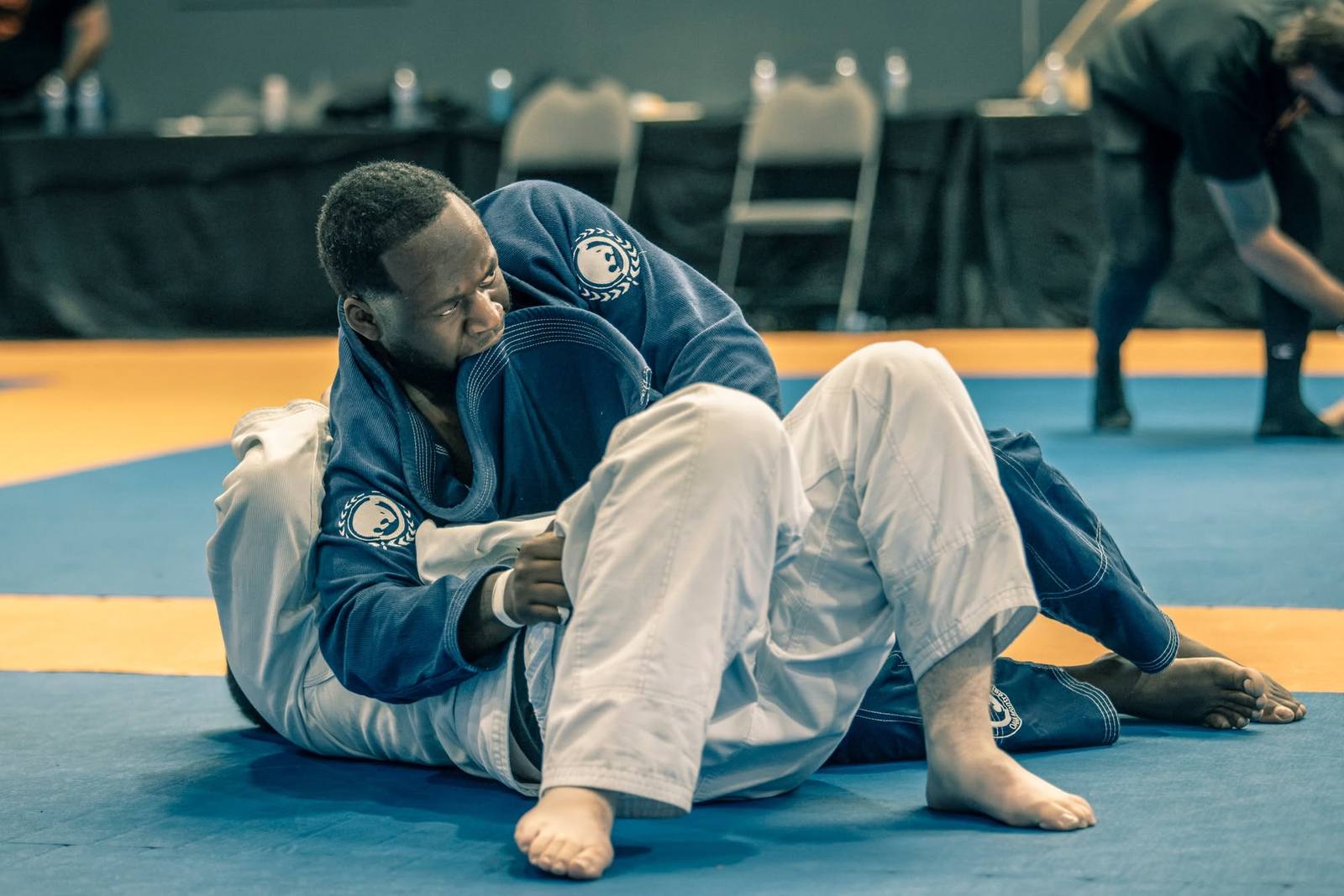
Will jiu-jitsu make you stronger and steadier after 30, and will your body hold up? The honest answer from 15 papers: training can build strength and balance and teach safer falling, but nobody has tested jiu-jitsu itself on adults over 30, and injuries are common, so build up gradually. Most evidence comes from judo, karate, taekwondo and boxing programs, and we name the sport each time.
The short answer
- You can get stronger. In two studies, judo-based training left working adults and older adults with stronger legs and better balance.[1][2]
- Expect better balance, not a promise of fewer falls. Balance improved in judo studies, but a review of 8 studies found Olympic combat sports did not reduce falls any more than other exercise.[4][7]
- You can learn to fall more softly. In lab tests, falling the martial arts way put less force on the hip, and beginners improved after a single lesson.[8][9]
- Expect a few knocks. In a large survey of adults, most reported an injury within six months, the knee most often, so build up gradually.[12][13]
No experience, no equipment. We can lend you a gi for the first 2 weeks.
What the studies found
| Study | Who | Sport | What they found |
|---|---|---|---|
| Arkkukangas and others, 2021 | 142 working adults, average age 47, 10 weeks | Judo-based program | Better balance, strength and falling than a comparison group; not randomized[1] |
| Kujach and others, 2022 | 40 older adults, 12 weeks | Judo | Stronger legs, better balance, faster on a focus test, higher BDNF (a brain protein)[2] |
| Valdes-Badilla and others, 2021 (review) | 12 trials, 735 adults aged 60 and over | Boxing, judo, karate, taekwondo | Stronger, fitter and calmer; more than 80% stuck with the classes[5] |
| Palumbo and others, 2023 (review) | 23 studies, 1,392 people over 50 | Judo | Helped bones, fitness, balance, fear of falling and confidence; most studies weak[4] |
| Valdes-Badilla and others, 2022 (review) | 8 studies, 322 older adults | Olympic combat sports | Contrary: no fewer falls and no lower fall risk than other exercise[7] |
| de Mendonca and others, 2025 (review) | 10 randomized trials in older adults | Adapted taekwondo, Muay Thai and others | Better ability to move and get around, but the evidence has low certainty[6] |
| Groen and others, 2007 | 6 experienced judo athletes, lab | Judo and martial arts falls | About 30% less force on the hip than catching the fall with the arm[8] |
| Weerdesteyn and others, 2008 | 10 young adults with no experience, lab | Martial arts falls | After one 30-minute lesson, 17% less force on the hip[9] |
| Groen and others, 2010 | 25 healthy older adults, five sessions | Martial arts falls | Learned the falls in five lessons; fear of falling dropped[10] |
| Jadczak and others, 2024 | 17 adults aged 66 to 87, 8 weeks | Judo-based program | Safe and improved how they moved; no comparison group[11] |
| Andreato and others, 2017 (review) | 58 studies, 1,496 athletes | Jiu-jitsu | Low body fat; strength and grip endurance linked to success. Athletes, not beginners[3] |
| Moriarty and others, 2019 | 1,287 adult practitioners, survey, 6 months | Jiu-jitsu | 59.2% reported an injury, the knee most often; more training days raised the risk, more years lowered it[12] |
| Hinz and others, 2021 | 1,140 athletes in 62 countries, survey | Jiu-jitsu | Injuries costing two weeks or more were mostly knees, from submissions in sparring[13] |
| Stegerhoek and others, 2025 | 881 weekly trainers (90% men, average age 31), survey | Jiu-jitsu | About 5.5 injuries per 1,000 training hours (self-reported 55.9 per 1,000 matches); knees and shoulders; higher belts had more[14] |
| Scoggin and others, 2014 | 5,022 matches at 8 Hawaii tournaments | Jiu-jitsu competition | Fewer than 1 in 100 matches ended in injury, lower than published figures for other combat sports[15] |
Does Jiu-Jitsu Make You Stronger and Fitter After 30?
Studies of judo-based and other combat-sport programs point that way, though none of them tested jiu-jitsu on beginners over 30. In one study, working adults (average age 47) did 10 weeks of judo-based training, and they ended up with better balance, strength and safer falling than a comparison group.[1] In another, older adults who did 12 weeks of judo got stronger legs and steadier balance.[2]
A review of boxing, judo, karate and taekwondo trials in people aged 60 and over found they got stronger, fitter and calmer, and more than 80% stuck with the classes.[5] That last part matters, because in our view the best training is the kind you keep doing.
Jiu-jitsu is a stop-and-go sport, with short hard efforts and pauses, and its athletes tend to have low body fat and strong grip, but that review covered athletes, not beginners.[3] In class we see a roll use your legs, grip and trunk all at once. That is our view, not a study result.
Does It Improve Balance and Prevent Falls?
Balance does improve, but nobody has shown that martial arts prevent falls. Judo-based training steadied the working adults and the older adults above,[1][2] and a review of judo studies in people over 50 found better balance and less fear of falling, although most of those studies were weak.[4]
In a review of 8 studies of older adults, people who did Olympic combat sports fell no less often than people who did other exercise.[7] In a small 8-week judo-based program, 17 adults aged 66 to 87 moved better and stayed safe, but there was no comparison group, so we cannot tell how much was the training.[11]
Does Learning to Fall Protect You?
In the lab, yes: falling the martial arts way put less force on the hip. Experienced judo athletes cut the force by about 30% compared with catching the fall with an arm,[8] and beginners hit the floor with 17% less force after a single 30-minute lesson.[9]
Older adults can learn it too: in a small pilot, 25 healthy older adults picked up the falls in five sessions, and they were less afraid of falling afterwards.[10] These were volunteers falling onto mats from kneeling, so no study has shown fewer broken hips in real life.
Is It Good for Bones and Healthy Ageing?
Possibly, and the best signal is for judo. In a review of judo for people over 50, bones, fitness, balance, fear of falling and confidence all improved, though most of the studies were weak.[4] Another review found that adapted martial arts helped older adults get around, but the evidence has low certainty.[6]
None of these studies used jiu-jitsu or followed people for decades.
Is Jiu-Jitsu Safe at Our Age?
In our view it suits most healthy adults who build up gradually, but injuries are common. In a survey of 1,287 adults, 59.2% reported an injury in six months, the knee most often.[12] In another, the injuries that cost two weeks or more came mostly from submissions in sparring.[13]
Your risk is not fixed. In one survey, more training days raised the risk and more years of experience lowered it.[12] In another, people reported about 5.5 injuries per 1,000 training hours, and more in higher belts.[14] That survey was self-reported; per 1,000 matches it found 55.9.[14]
Medical records from 8 Hawaii tournaments tell a gentler story: fewer than 1 in 100 matches ended in an injury, lower than published figures for judo, taekwondo, wrestling and MMA.[15]
From our own practice, not from these studies: learn technique and drilling before hard sparring, tap early and often, train two or three times a week at first, and tell your partner about any old injury. If you have a heart, joint or bone condition, or you have not exercised in years, check with your doctor first.
What the Research Does Not Show
No trial has tested jiu-jitsu on adults over 30. The studies used adapted judo, karate, taekwondo and boxing programs, and only one of them was about working-age adults (average age 47), so for your 30s and 40s we are reading across from older people.
In the review of older adults, Olympic combat sports did not lower falls or fall risk.[7] The falling studies were small lab tests, so they show less force on the hip, not fewer broken bones. Many training studies were small too, and the evidence has low certainty.[6]
The injury surveys are self-reported, mostly men and mostly competitors or volunteers, so they cannot tell you your own risk.[13][14] Take the numbers above as a map, not a forecast for your own body.
Keep Reading
Next in the seriesA Better Man: Self-Control, Anger, Health Habits and Purpose on the MatHealth habits are the next layer after strength: in one survey of three groups of men, those who trained combat sports reported the best everyday health habits. Next in the seriesA Stronger Woman: Self-Defense, Confidence and Body ImageBody image is the next layer after strength: in a randomized trial, older women new to taekwondo felt better about themselves and their bodies after 12 weeks. Next in the seriesJiu-Jitsu for Adults: What the Research Really Shows About Fitness, Stress and ConfidenceOne survey in our safety section, of 881 practitioners, is also in this one-page overview of fitness, stress and confidence.More for adults:
- How Jiu-Jitsu Transforms Your Fitness at Any Age
- Adult BJJ Fundamentals - Your First 6 Months
- Starting Jiu-Jitsu at 35+: Your Complete Guide
When Are Classes?
| Group | Ages | Weekdays | Saturday |
|---|---|---|---|
| Adults | 14 and over | Mon to Thu 7:15 PM | 10:45 AM |
Classes are taught in French and English. We can lend you a gi for the first 2 weeks. First time? Here is what to expect at a first class.
Ready to join? Register online in a few minutes.
References
We chose randomized trials and reviews first, and we kept the results that do not go our way. Each link opens the study's official summary in its journal or in PubMed.
- Arkkukangas M, Baathe KS, Ekholm A, Tonkonogi M (2021). A 10-week judo-based exercise programme improves physical functions such as balance, strength and falling techniques in working age adults. BMC Public Health 21(1):744. https://pubmed.ncbi.nlm.nih.gov/33865349/
- Kujach S, Chroboczek M, Jaworska J, Sawicka A, Smaruj M, Winklewski P, Laskowski R (2022). Judo training program improves brain and muscle function and elevates the peripheral BDNF concentration among the elderly. Scientific Reports 12(1):13900. https://pubmed.ncbi.nlm.nih.gov/35974038/
- Andreato LV, Diaz Lara FJ, Andrade A, Branco BHM (2017). Physical and Physiological Profiles of Brazilian Jiu-Jitsu Athletes: a Systematic Review. Sports Medicine - Open 3:9. https://doi.org/10.1186/s40798-016-0069-5
- Palumbo F, Ciaccioni S, Guidotti F, Forte R, Sacripanti A, Capranica L, Tessitore A (2023). Risks and Benefits of Judo Training for Middle-Aged and Older People: A Systematic Review. Sports (Basel) 11(3):68. https://pubmed.ncbi.nlm.nih.gov/36976954/
- Valdes-Badilla P, Herrera-Valenzuela T, Ramirez-Campillo R, Aedo-Munoz E, Baez-San Martin E, Ojeda-Aravena A, Branco BHM (2021). Effects of Olympic Combat Sports on Older Adults' Health Status: A Systematic Review. International Journal of Environmental Research and Public Health 18(14):7381. https://pubmed.ncbi.nlm.nih.gov/34299833/
- de Mendonca DLC, Raider Junior JM, da Silva LBB, et al. (2025). Benefits of martial arts on the functional capacity of elderly people: a systematic review and meta-analysis. Clinics (Sao Paulo) 80:100830. https://pubmed.ncbi.nlm.nih.gov/41253097/
- Valdes-Badilla P, Ramirez-Campillo R, Herrera-Valenzuela T, et al. (2022). Effectiveness of Olympic Combat Sports on Balance, Fall Risk or Falls in Older Adults: A Systematic Review. Biology (Basel) 11(1):74. https://pubmed.ncbi.nlm.nih.gov/35053071/
- Groen BE, Weerdesteyn V, Duysens J (2007). Martial arts fall techniques decrease the impact forces at the hip during sideways falling. Journal of Biomechanics 40(2):458-462. https://pubmed.ncbi.nlm.nih.gov/16480724/
- Weerdesteyn V, Groen BE, van Swigchem R, Duysens J (2008). Martial arts fall techniques reduce hip impact forces in naive subjects after a brief period of training. Journal of Electromyography and Kinesiology 18(2):235-242. https://pubmed.ncbi.nlm.nih.gov/17764975/
- Groen BE, Smulders E, de Kam D, Duysens J, Weerdesteyn V (2010). Martial arts fall training to prevent hip fractures in the elderly. Osteoporosis International 21(2):215-221. https://pubmed.ncbi.nlm.nih.gov/19407919/
- Jadczak AD, Verma M, Headland M, Tucker G, Visvanathan R (2024). A Judo-Based Exercise Program to Reduce Falls and Frailty Risk in Community-Dwelling Older Adults: A Feasibility Study. Journal of Frailty & Aging 13(1):1-9. https://pubmed.ncbi.nlm.nih.gov/38305437/
- Moriarty C, Charnoff J, Felix ER (2019). Injury rate and pattern among Brazilian jiu-jitsu practitioners: A survey study. Physical Therapy in Sport 39:107-113. https://pubmed.ncbi.nlm.nih.gov/31288212/
- Hinz M, Kleim BD, Berthold DP, Geyer S, Lambert C, Imhoff AB, Mehl J (2021). Injury Patterns, Risk Factors, and Return to Sport in Brazilian Jiu Jitsu: A Cross-sectional Survey of 1140 Athletes. Orthopaedic Journal of Sports Medicine 9(12):23259671211062568. https://pubmed.ncbi.nlm.nih.gov/34988235/
- Stegerhoek PM, Brajovic B, Kuijer P, Mehrab M (2025). Injury prevalence among Brazilian Jiu-Jitsu practitioners globally: a cross-sectional study in 881 participants. BMJ Open Sport & Exercise Medicine 11(1):e002322. https://pubmed.ncbi.nlm.nih.gov/40092168/
- Scoggin JF, Brusovanik G, Izuka BH, Zandee van Rilland E, Geling O, Tokumura S (2014). Assessment of Injuries During Brazilian Jiu-Jitsu Competition. Orthopaedic Journal of Sports Medicine 2(2):2325967114522184. https://doi.org/10.1177/2325967114522184