 EN
 FR
 中文
 ES
 PT
 عربي
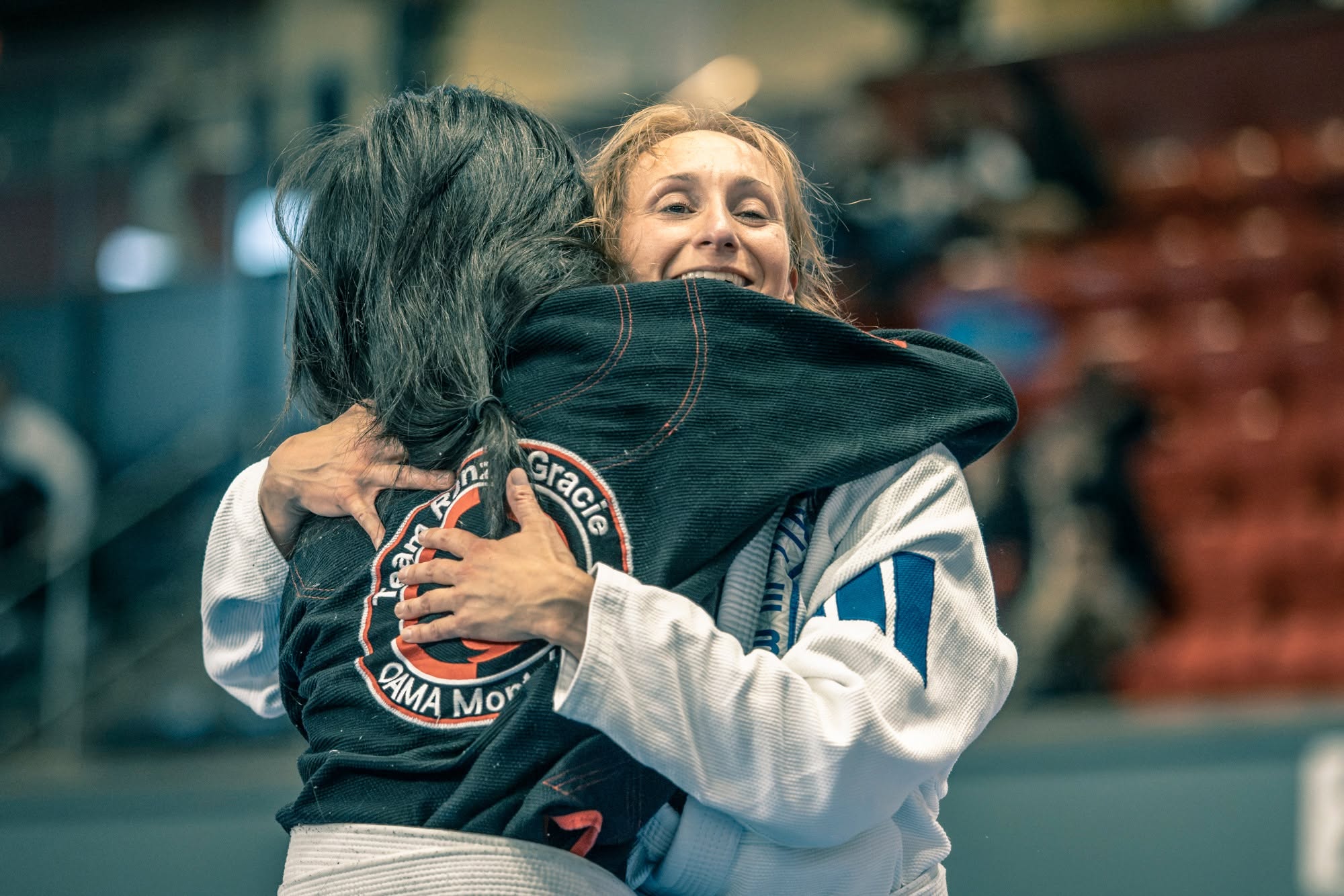
Can learning to defend yourself make you stronger, more confident and more at home in your body? The honest answer from 12 studies is yes for confidence, promising but never guaranteed for safety, and encouraging for body image. Most of these studies tested self-defense programs or martial arts other than jiu-jitsu, and we say which one every time.
The short answer
- Confidence: in a trial where 893 university women were assigned by chance, a 12-hour self-defense course left them feeling more able to defend themselves, and they still felt that way 2 years later.[1][2]
- Safety: in that same trial, women who took the course were raped about half as often the next year. A school trial in South Africa saw no real drop, so none of this is a guarantee.[1][6]
- Jiu-jitsu: nurses who took a jiu-jitsu-based course felt more confident handling violence at work, and women who trained striking arts (Muay Thai, boxing, taekwondo), not jiu-jitsu, scored higher on parts of resilience but lower on commitment.[7][8]
- Body image: older women who started taekwondo felt better about themselves and their bodies within 12 weeks, and amateur women felt as self-assured as elite athletes.[10][11]
No experience, no equipment. We can lend you a gi for your first 2 weeks.
What the studies found
| Study | Who | Sport | What they found |
|---|---|---|---|
| Senn and others, 2015 and 2017 | 893 first-year women, 3 Canadian universities | Self-defense program, verbal and physical (not a martial art) | Completed rape about half as common the next year (5.2% vs 9.8%); confidence in defending themselves rose and stayed up for 2 years [1][2] |
| Hollander, 2014 | University women, 10-week class, 1-year follow-up | Feminist self-defense (not jiu-jitsu) | More confident they could resist an attack and less likely to be assaulted. Not randomized: the women chose the class [3] |
| Sinclair and others, 2013 | 522 girls aged 14 to 21, Nairobi | Self-defense course | Sexual assault fell from 24.6% to 9.2% in the course group. Assigned by school, not randomized [4] |
| Brecklin and Ullman, 2005 (survey) | 1,623 women who had been attacked | Self-defense or assertiveness training, style not given | Women who had trained before an attack were more likely to say their resistance stopped the attacker, and felt less fear [5] |
| Hartmann and others, 2025 | 1,540 girls aged 10 to 19, 15 schools, South Africa | Empowerment self-defense | Contrary: sexual violence did not drop significantly; only self-defense knowledge rose [6] |
| Ma and others, 2026 | 280 nurses (133 jiu-jitsu course, 147 classroom) | Brazilian jiu-jitsu-based self-defense | More confidence handling violence than classroom training. Not randomized [7] |
| Pekel and others, 2025 (survey) | 802 women: 407 martial artists, 395 Pilates | Muay Thai, kickboxing, boxing, taekwondo | Higher on the control and challenge parts of resilience, lower on commitment [8] |
| de Lorenco-Lima and others, 2025 (survey) | 420 jiu-jitsu practitioners, 89 of them women | Brazilian jiu-jitsu | Women with higher life satisfaction and lower aggression had better mental health [9] |
| Linhares and others, 2025 | 27 women aged 60 to 70, low bone density, 12 weeks | Taekwondo | Self-esteem and body image improved. A small randomized trial [10] |
| Gonen and others, 2026 (survey) | 233 women, 107 elite and 126 amateur, Turkey | Taekwondo | Amateurs were as well and as self-assured as elite athletes; body image mattered more than level [11] |
| Cho and Roh, 2019 | 37 women aged 65 and over, 16 weeks | Taekwondo | Strength, brain growth factors (BDNF) and an attention-test score all rose [12] |
Does Self-Defense Training Make Women More Confident?
Yes, and this is the best-supported finding in the whole field. In a Canadian trial, 893 first-year university women either took a 12-hour course or were handed brochures. The women who took the course felt more able to defend themselves, and two years later that confidence had not faded.[2]
A university class that ran for 10 weeks told the same story: the women came out more sure they could resist an attack.[3] In that study the women chose the class themselves, which can make a result look better than it is.
None of these programs was a martial art. They taught talking and physical skills together, so read them as evidence for self-defense training in general. Why would it work? That is our view as coaches, not a study result: confidence grows when you practise a skill under pressure with a partner who pushes back, not when someone tells you that you are capable.
Does It Make Women Safer?
Maybe, but nobody can promise it. In the Canadian trial, 5.2% of women who took the course were raped in the following year, against 9.8% of women who only got brochures. Over two years, the course cut completed and attempted rape, attempted coercion and unwanted sexual contact by 30% to 64%.[1][2]
A study of girls in Nairobi saw sexual assault fall from 24.6% to 9.2% after a self-defense course. The schools were assigned to the course and not picked by chance, so it is weaker evidence.[4]
Then there is the result that points the other way. In South Africa, 1,540 girls in 15 schools were followed, and sexual violence did not drop. What went up was knowledge of self-defense, and schools found the program hard to run.[6] A survey of women who had been attacked adds a smaller piece: those who had trained beforehand were more likely to say their resistance stopped the attacker, and they felt less fear.[5]
So here is what we will say. Training builds skill and confidence. It cannot promise that no one will ever hurt you, and the responsibility for violence always sits with the person who commits it.
What About Jiu-Jitsu Specifically?
The jiu-jitsu evidence is thinner, but it leans the same way. In a study of 280 nurses, those who took a jiu-jitsu-based self-defense course gained more confidence in handling violence at work than those who only had classroom training. The groups were not chosen by chance, and the abstract does not say how many were women.[7]
One survey asked 420 jiu-jitsu practitioners, 89 of them women, about their lives. The women who felt happier and less aggressive also had better mental health. A survey like this cannot say training was the reason.[9]
Another survey compared women who did Pilates with women who trained punching and kicking arts, such as Muay Thai, boxing and taekwondo. The martial artists felt more in control and more ready for a challenge, but less committed.[8] That is not grappling, and it is a snapshot, not a trial.
In a jiu-jitsu class you practise being held, staying calm and finding a way out against a partner who resists, and you can tap to stop whenever you need to. That is what we see in class, not a study result. None of the studies above compared jiu-jitsu with other self-defense programs.
Does Training Change How Women See Their Bodies?
It can, though there is less evidence. In a trial of 27 women aged 60 to 70 with low bone density, all new to taekwondo, self-esteem and body image both improved over 12 weeks.[10]
In a survey of 233 women taekwondo athletes in Turkey, how a woman saw her body said more about her well-being than whether she competed at an elite level.[11] A third study followed 37 women aged 65 and over through 16 weeks of taekwondo and found gains in strength, in a brain growth protein (BDNF) and in an attention test.[12] Strength and self-image rose in different studies, and none of them tested whether one drives the other.
Do I Need to Be Fit, Young or Competitive?
No. In the Turkish survey, amateur women were as well and as self-assured as elite athletes.[11] The taekwondo trials involved women in their 60s and older.[10][12] The Canadian course was only 12 hours long, and it still showed effects 2 years later.[1][2] Competing is a choice, not a requirement.
What the Research Does Not Show
No trial has ever put a jiu-jitsu class up against assault. The big trials tested short self-defense programs in universities and schools, not martial arts in a gym, so we cannot tell you what a year on the mat would do.
The safety results pull in different directions, with a clear drop in Canada and none in South Africa. Please do not read this essay as proof that training prevents assault.
The jiu-jitsu evidence is one study of nurses and one survey. The body-image trial followed just 27 older women, all in taekwondo. And in several studies the women chose to train, so the women who sign up may simply differ from the women who do not.
Keep Reading
Next essayCalmer, steadier, harder to rattle: anxiety, mood and resilienceA 12-hour course lifted self-defense confidence for 2 years. The next essay looks at the wider mental side, where a 2025 analysis found taekwondo eased depression, most clearly in older women.Related reading:
When Are Classes?
| Group | Weekdays | Saturday |
|---|---|---|
| Adults (14+) | Mon to Thu, 7:15 PM | 10:45 AM |
Classes start after work, so you can train on your way home. First time? Here is what to expect at your first class.
Your first class is free
Pick a class, come 10 minutes early, and we can lend you a gi for the first 2 weeks.
Book a free trialReady to join? Register online.
References
We chose randomized trials and reviews first, and we kept the results that do not go our way. Each link opens the study's official summary in its journal or in PubMed.
- Senn CY, Eliasziw M, Barata PC, Thurston WE, Newby-Clark IR, Radtke HL, Hobden KL (2015). Efficacy of a sexual assault resistance program for university women. N Engl J Med 372(24):2326-2335. https://doi.org/10.1056/nejmsa1411131
- Senn CY, Eliasziw M, Hobden KL, Newby-Clark IR, Barata PC, Radtke HL, Thurston WE (2017). Secondary and 2-Year Outcomes of a Sexual Assault Resistance Program for University Women. Psychol Women Q 41(2):147-162. https://doi.org/10.1177/0361684317690119
- Hollander JA (2014). Does self-defense training prevent sexual violence against women?. Violence Against Women 20(3):252-269. https://doi.org/10.1177/1077801214526046
- Sinclair J, Sinclair L, Otieno E, Mulinge M, Kapphahn C, Golden NH (2013). A self-defense program reduces the incidence of sexual assault in Kenyan adolescent girls. J Adolesc Health 53(3):374-380. https://doi.org/10.1016/j.jadohealth.2013.04.008
- Brecklin LR, Ullman SE (2005). Self-defense or assertiveness training and women's responses to sexual attacks. J Interpers Violence 20(6):738-762. https://doi.org/10.1177/0886260504272894
- Hartmann M, Mutangabende S, Nash S, Browne EN, Hatcher A, Kagesten AE, Roberts ST (2025). Effectiveness of an empowerment-based self-defense program among South African girls: results from a cluster-randomized control trial in schools. BMC Womens Health 25(1):119. https://doi.org/10.1186/s12905-025-03647-w
- Ma CY, Liao SJ, Chang YC, Chiang HH (2026). Effectiveness of a theory-driven Brazilian jiu-jitsu-based medical self-defense training for nurses facing workplace violence: A multicenter quasi-experimental study. Int J Nurs Stud 173:105260. https://doi.org/10.1016/j.ijnurstu.2025.105260
- Pekel A, Turan MB, Eraslan M, Iqbal M, Pepe O, Yoka K, Yoka O (2025). Building resilience through self-defense: the role of martial arts in enhancing psychological strength among women. Front Psychol 16:1592326. https://doi.org/10.3389/fpsyg.2025.1592326
- de Lorenco-Lima L, Gaines SA, Waterbury EM (2025). Aggression, self-control, life satisfaction, and resilience as predictors of mental health in Brazilian jiu-jitsu athletes. Front Sports Act Living 7:1692536. https://doi.org/10.3389/fspor.2025.1692536
- Linhares D, da Silva GCPSM, Meireles AS, et al. (2025). Self-Esteem and Body Image in Older Women Practicing Taekwondo with Low Bone Density: A Randomized Clinical Trial. Curr Aging Sci 18(1):73-79. https://doi.org/10.2174/0118746098308597240527114223
- Gonen M, Turkmen M, Cakir Z, Ari F, Catikkas F (2026). Psychological well-being, body image and self-esteem in elite and amateur female taekwondo athletes in Turkiye. BMC Psychol 14(1):985. https://doi.org/10.1186/s40359-026-04628-w
- Cho SY, Roh HT (2019). Taekwondo Enhances Cognitive Function as a Result of Increased Neurotrophic Growth Factors in Elderly Women. Int J Environ Res Public Health 16(6):E962. https://doi.org/10.3390/ijerph16060962