 EN
 FR
 中文
 ES
 PT
 عربي
Will training make you calmer and harder to rattle? Probably, by a small to medium amount, though the proof is thinner than we would like. Only a few of the studies were trials, none of the trials tested jiu-jitsu, and most used taekwondo or martial arts in general, so we name the sport every time.
The short answer
- Stress fell more with martial arts than with ordinary exercise in a small eight-week trial of 66 young adults, and their emotional control and resilience rose too.[1]
- Low mood eased a moderate amount in taekwondo trials, most clearly in older women.[2][3]
- Resilience was higher in people who trained, and jiu-jitsu black belts scored above white belts, though a survey cannot show that training was the cause.[4][5]
- Treatment is a different matter: the adult evidence is still mixed, so training can sit beside professional care but never replace it.[8]
No experience, no equipment. We can lend you a gi for the first 2 weeks.
What the studies found
| Study | Who | Sport | What they found |
|---|---|---|---|
| Randomized trial, 2026 | 66 adults aged 18 to 25 | Martial arts (style not named) | Less stress, more emotional control and resilience than ordinary exercise; small trial [1] |
| Meta-analysis of 14 trials, 2025 | 906 people | Taekwondo | Moderate drop in depressive symptoms and moderate gain in thinking [2] |
| Meta-analysis of 15 trials, 2025 | 1,945 people | Taekwondo | Lower depression scores, clearest in older women [3] |
| Meta-analysis of 14 studies, 2020 | Children, teens and adults | Various martial arts | Small lift in wellbeing, medium drop in anxiety and low mood, no change in aggression [7] |
| Review of 72 studies, 2024 | Adults | Martial arts, combat sports | Mixed: links with wellbeing and emotion regulation were inconclusive [8] |
| Survey, 2025 | 1,291 first-year college students | Martial arts (styles not named) | Those who had trained were more resilient and had more self-control [4] |
| Survey, 2025 | 420 people aged 18 to 60 | Brazilian jiu-jitsu | Black belts scored higher than white belts on mental strength, resilience and self-control [5] |
| Survey, 2025 | University students, 10 universities | Combat sports (styles not named) | More combat sport went with higher wellbeing [6] |
| Survey, 2026 | 268 practitioners | Martial arts, combat sports | Health benefits reported at any training volume; perceived, not measured [9] |
Does martial arts training lower anxiety and stress?
Probably, by a small to medium amount. A review of 14 studies of different martial arts found people felt a little better overall and noticeably less anxious or low.[7] The studies mixed children, teens and adults and varied a lot, so treat the size as rough.
The newest evidence is a 2026 trial in which adults aged 18 to 25 did martial arts, ordinary exercise or nothing for eight weeks. The martial arts group ended with less stress and more emotional control and resilience than the exercise group.[1] It was a small trial and the abstract does not name the style, so take it as a promising sign, not a verdict.
Reviews of adults alone are more cautious. One that covered 72 studies could not say for sure that martial arts improve wellbeing or how people manage their emotions, though it found firmer signs that practitioners are better at holding back an impulse.[8] Almost all of those studies compared people who chose the sport with people who did not.
If you have ever left a hard round feeling lighter than you arrived, that is the experience these studies try to measure. In class we see people walk in carrying their day and walk out a little quieter. That is our view, not a study result.
Can training help with low mood and depression?
In taekwondo trials, yes, by a moderate amount. A 2025 review gathered 14 trials in which people were assigned by chance to train or not, and found their low mood eased and their thinking sharpened by a moderate amount.[2]
A second review, of 15 such trials, also found lower depression scores. The effect was clearest in older women, and in programs that ran for 12 weeks with three sessions a week.[3] In both reviews the trials differed a lot from one another, so the numbers show a pattern, not a prescription.
Both reviews are about taekwondo, not jiu-jitsu. And jiu-jitsu is not a treatment: if you live with anxiety or depression, training can sit alongside care from a professional, never replace it.
Does it make you harder to rattle?
It seems to, though the proof is thinner. In a survey of 1,291 first-year college students, those who had trained in martial arts bounced back from stress better, and part of that came from having more self-control.[4] The styles were not named, and a survey cannot show that training came first.
The only jiu-jitsu data sit here. In a survey of 420 BJJ practitioners, black belts scored higher than white belts on mental strength, resilience, self-control and life satisfaction, with no more aggression.[5] Black belts have trained far longer and may differ from people who quit, so the survey cannot say whether the belt or the person made the difference.
A third survey, of students at 10 universities, found that the more combat sport they did, the better they felt, and that better emotional intelligence and higher self-esteem helped explain why.[6] The styles were not named here either, and it was a survey.
You can see why this might matter in class. A white belt who is pinned learns to breathe, wait and look for the exit instead of panicking, and a few months later does it without thinking. That is our coaching view, and the studies did not measure it.
Why would a contact sport change how you cope?
Probably because it practises a few skills that matter everywhere else. The studies keep pointing at emotional control, self-control, emotional intelligence, self-esteem and the ability to stop an impulse.[1][4][6][8] None of them belongs only to jiu-jitsu.
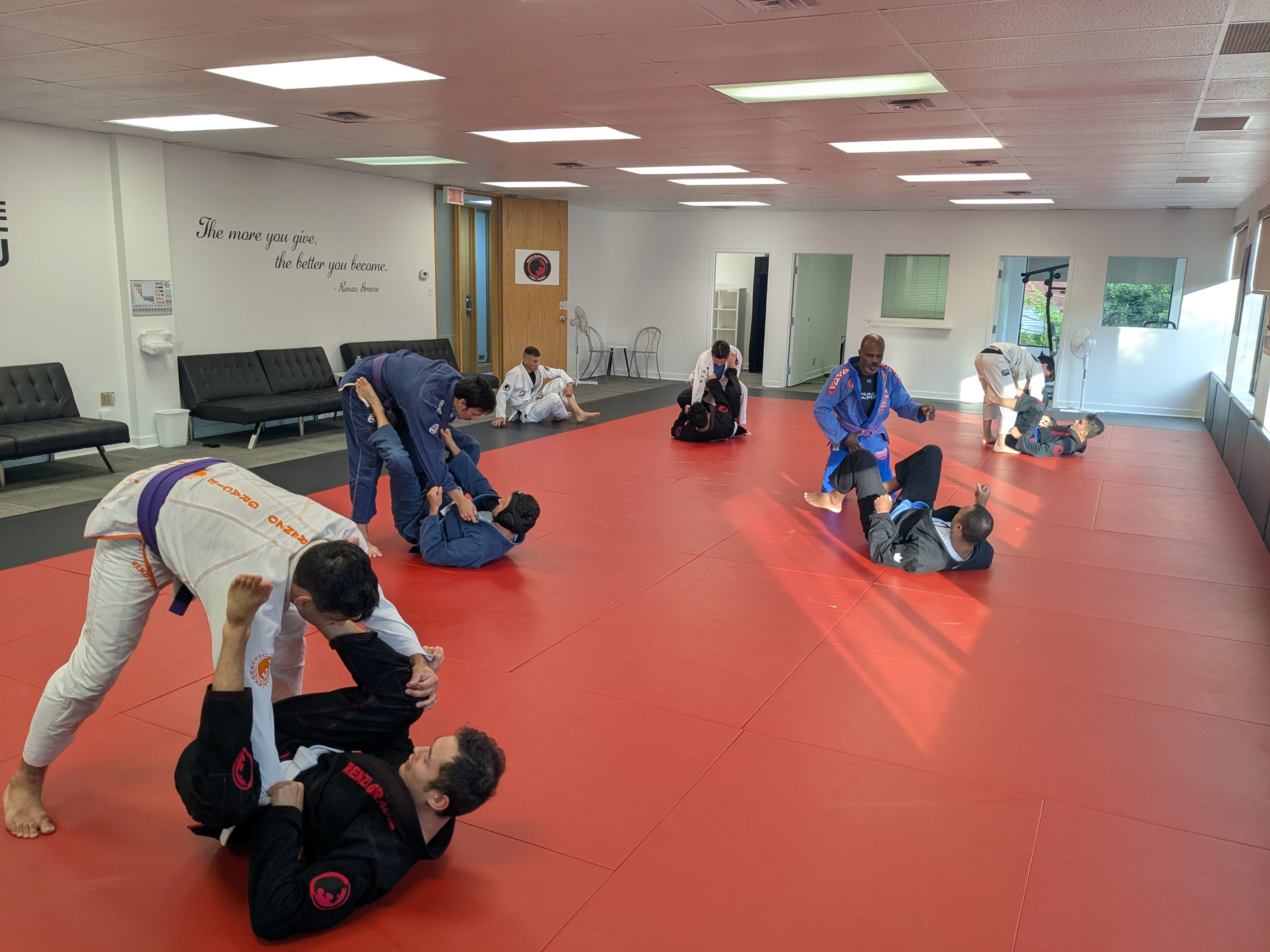
Here is what it looks like in class. You stay calm in a bad position against a partner who resists, you tap when you are caught, and you start again, round after round. That is what we see on the mat, not a study result: nobody has yet tested in a trial whether that routine produces the change.
How much training does it take?
There is no single number. In a survey of 268 martial arts and combat sport practitioners, people reported health benefits whatever their years of training or how often they trained.[9] Those benefits were felt, not measured, and the people chose to answer an online survey.
In the taekwondo reviews, the programs with the clearest effect on depression ran 12 weeks with three sessions a week.[3] That is one pattern from one review, not a promise. If you are starting later in life, our guide to starting jiu-jitsu later in life covers the first months, and the pace is yours to set.
What the research does not show
No one has run a trial that assigns people to jiu-jitsu to see what it does for anxiety, mood or resilience. The trials we have used taekwondo or unnamed martial arts, and the BJJ numbers come from surveys.[5]
Surveys cannot prove cause. Calmer people may be the ones who stay in the sport, and black belts are the people who did not quit.[4][5][6]
Across all adult studies the picture is still mixed, and the 2026 trial had only 66 people aged 18 to 25.[1][8] The depression results come from taekwondo trials that differed from one another,[2][3] and in the 268-person survey the health benefits were how people felt, not something measured.[9]
And no study here shows that jiu-jitsu treats anxiety or depression.
Keep reading
Your brain chemistry on jiu-jitsu: stress hormones, BDNF, oxytocinAlso related:
- Sharper focus at any age: attention, memory and self-control: self-control is the skill that links this essay to focus and memory.
- A better man: self-control, anger, health habits and purpose: self-control and mental health in men, and what the research says about aggression.
- Jiu-jitsu for adults: what the research really shows: the one-page overview, with fitness and injury numbers.
When are classes?
| Group | Weekdays | Saturday |
|---|---|---|
| Adults (14+) | Mon to Thu, 7:15 PM | 10:45 AM |
Classes start after work, so you can train on your way home. Kids train right after school: see the kids schedule. If you are starting later in life, read our guide to starting jiu-jitsu at 35.
Your first class is free
Pick a class, come 10 minutes early, and we can lend you a gi for the first 2 weeks.
Book a free trialReady to join? Register online.
References
We chose randomized trials and reviews first, and we kept the results that do not go our way. Each link opens the study's official summary in its journal.
- Zheng C, Zhou J, Ji C (2026). Martial arts training as a psychological self-regulation intervention: an experimental study on emotional control, attention, and stress resilience. Front Psychol 17:1787259. https://doi.org/10.3389/fpsyg.2026.1787259
- Chen A, Tian X, Ma X (2025). The effects of taekwondo on depression symptoms and cognitive function: a systematic review and meta-analysis. Front Sports Act Living 7:1735531. https://doi.org/10.3389/fspor.2025.1735531
- Gao Y, Han Z, Dai B (2025). The Effect of Taekwondo on Depression: A Meta-Analysis. Iran J Public Health 54(2):252-264. https://doi.org/10.18502/ijph.v54i2.17897
- Tao C, Li Y (2025). The relationship between martial arts practice experience and psychological resilience among Chinese college freshmen. Front Psychol 16:1686000. https://doi.org/10.3389/fpsyg.2025.1686000
- de Lorenco-Lima L, Gaines SA, Waterbury EM (2025). Rank-Based Psychological Characteristics in Brazilian Jiu-Jitsu Athletes. J Funct Morphol Kinesiol 10(2):100. https://doi.org/10.3390/jfmk10020100
- Ying L, Yang Q (2025). The impact of combat sports on undergraduate students' subjective well-being: chain mediation effects of emotional intelligence and self-esteem. Front Psychol 16:1659084. https://doi.org/10.3389/fpsyg.2025.1659084
- Moore B, Dudley D, Woodcock S (2020). The effect of martial arts training on mental health outcomes: A systematic review and meta-analysis. Journal of Bodywork and Movement Therapies 24(4):402-412. https://doi.org/10.1016/j.jbmt.2020.06.017
- Ciaccioni S, Castro O, Bahrami F, et al. (2024). Martial arts, combat sports, and mental health in adults: A systematic review. Psychology of Sport and Exercise 70:102556. https://doi.org/10.1016/j.psychsport.2023.102556
- Zormann E, Foramitti M, Nater UM (2026). Perceived health benefits of martial arts and combat sports. Front Psychol 17:1774069. https://doi.org/10.3389/fpsyg.2026.1774069
This article summarises published research for general information. It is not medical advice. If you live with anxiety, depression or another health condition, talk to your doctor before starting a new sport.