 EN
 FR
 中文
 ES
 PT
 عربي
Can a martial art really make your child calmer, more focused and more confident? The honest answer from 12 studies: often yes for focus, confidence and fitness, but it is not a cure for aggression or bullying. Most of these studies used taekwondo, judo or school programs rather than jiu-jitsu, and we say which every time.
The short answer
- Focus and self-control: in school trials, children who trained paid attention better and had fewer behaviour problems.[1][2]
- Confidence: a 10-week program raised teenagers' resilience and self-belief, and the self-belief lasted.[3][4]
- Fitness: the most consistent result of all, with better strength, balance and coordination.[5][6]
- Aggression and bullying: no clear effect either way. How the club teaches matters most.[7][8][9]
No experience, no equipment. We can lend your child a gi for the first 2 weeks.
What the studies found
| Study | Who | Sport | What they found |
|---|---|---|---|
| Lakes and Hoyt, 2004 | 207 children, kindergarten to grade 5, USA | Taekwondo | More self-control and better class conduct than regular gym class [1] |
| Ng-Knight and others, 2022 | 240 children aged 7 to 11, UK | Taekwondo | Better attention, fewer behaviour problems; other measures did not change [2] |
| Moore and others, 2021 and 2023 | 283 students aged 12 to 14, Australia | School martial arts program | Resilience up; self-belief up and still higher months later [3][4] |
| Moore and others, 2020 (review) | 14 studies, all ages | Several martial arts | Small gain in wellbeing, medium drop in anxiety and low mood; no change in aggression [10] |
| Two reviews, 2022 and 2025 | 1,615 children; 22 judo studies | Karate, judo, aikido, taekwondo | Better fitness, strength, balance and coordination [5][6] |
| Blomqvist Mickelsson, 2020 | 113 young people, Sweden | Jiu-jitsu and MMA | More self-control; aggression down in jiu-jitsu. Not randomized [11] |
| Benitez-Sillero and others, 2023 (survey) | 2,025 young people, Spain | Wrestling-type activities | Contrary: more bullying involvement. A survey cannot show cause [9] |
Will Jiu-Jitsu Help My Child Focus and Stay in Control?
Probably, if the research on similar martial arts carries over. In one school trial, 207 children who did taekwondo gained more self-control and better classroom conduct than children in regular gym class.[1] A newer trial with 240 children aged 7 to 11 found better attention and fewer behaviour problems after 11 weeks.[2] The first study covered one school and a short program, so read it as a strong hint rather than the final word.
Not everything moved. Several other self-control tests stayed the same, and the teachers knew who had trained.
Here is why it makes sense to us. A class is a long run of small exercises in stopping and listening: wait for the signal, watch, try, let go the moment your partner taps.
Will a Contact Sport Make My Child More Confident?
The research points that way. In an Australian trial, a 10-week martial arts program raised the resilience of 283 students aged 12 to 14.[3] Their belief that they could handle a challenge went up too, and it was still higher months later.[4]
Two details keep this honest. The students rated their own resilience on questionnaires, and the effect was clearest right after the program and weaker 12 weeks later.[3]
In jiu-jitsu, that belief is earned on the mat, not handed out as praise. Your child gets pinned, stays calm and finds the way out, again and again, under rules that keep everyone safe. A shy child often finds this easier than a team sport, because the work is one partner at a time. That last part is our coaching view: the studies measured the result, not the reason.
Is It Good Exercise for Kids?
Yes, and this is the most consistent finding. A review of 16 studies with 1,615 children in karate, judo, aikido and taekwondo found better cardio, speed, agility, strength, flexibility, coordination and balance.[5] The children in those programs ranged from preschool to school age.
Judo, the closest relative of jiu-jitsu, shows the same pattern across 22 studies, though most of them only observed children.[6] For a child who sits all day, crawling, rolling, pushing and pulling is a full-body workout that feels like play. None of these reviews included jiu-jitsu, so we read them as a guide, not a promise.
Will It Make My Child Aggressive, or Stop Bullying?
Neither is settled, and the club matters more than the sport. A 10-week school program neither raised nor lowered aggression,[7] and a 2026 review of 11 studies found no consistent effect either way.[8] An older review of 27 studies said the coaching and the setting seem to make the difference.[12]
No trial has tested whether training protects a child from bullying. One survey of 2,025 young people in Spain even found more bullying involvement in wrestling-type activities, though a survey cannot show cause.[9] The only jiu-jitsu study we found saw aggression go down in the jiu-jitsu group, but the young people chose their own sport.[11]
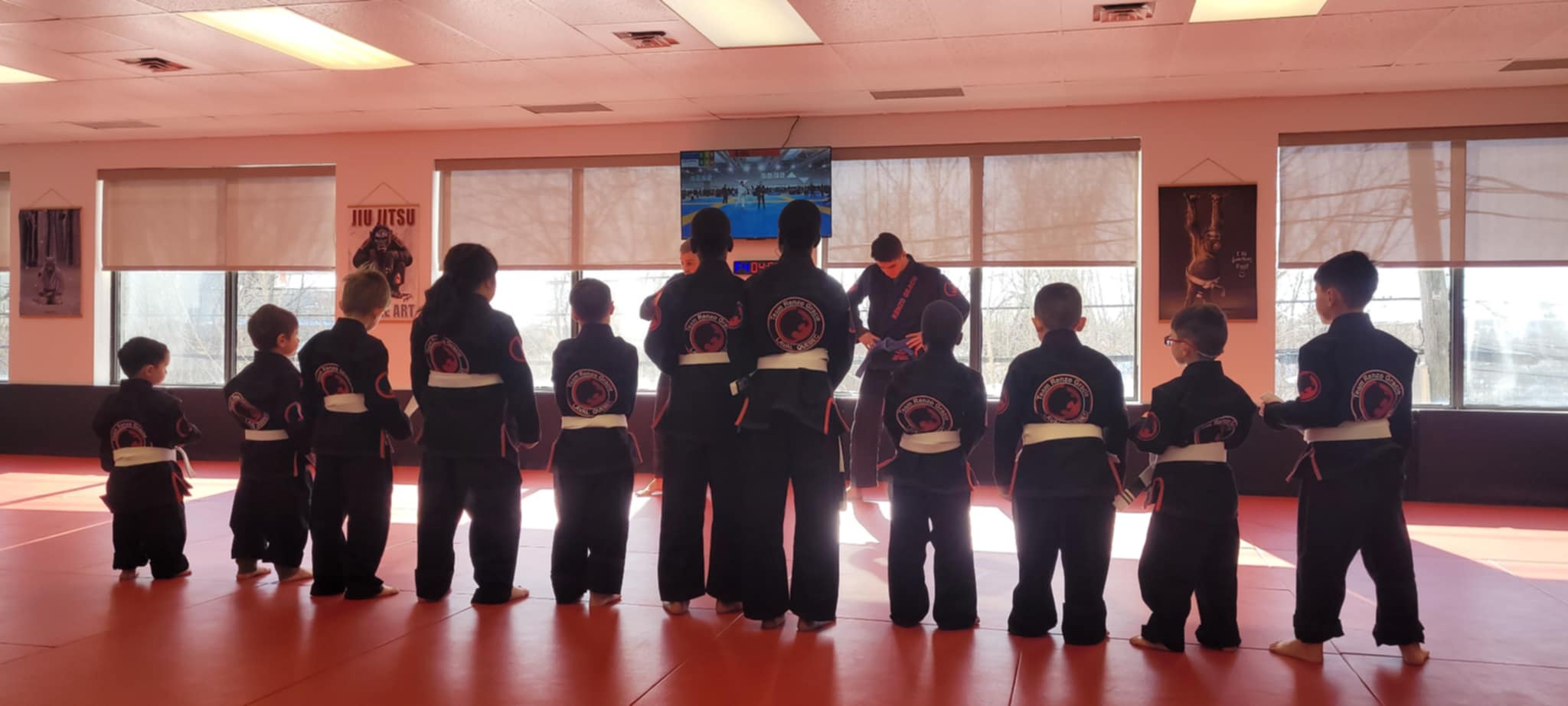
So look at how a club teaches: coaches who stop rough play at once, partners matched by age and size, beginners welcomed and parents able to watch. At Gracie Laval, kids classes have no striking. For the day-to-day changes families notice, read raising calmer, more confident kids.
See it for yourself
Watch your child's first class from the side of the mat. It's free.
Book a free trialWhen Are Classes?
| Group | Ages | Weekdays | Saturday |
|---|---|---|---|
| Apprentice | 3 to 4 | Mon, Tue, Wed 5:00 PM | 8:30 AM |
| Junior | 5 to 8 | Mon, Tue, Wed 5:30 PM | 9:00 AM |
| Teens | 9 to 13 | Mon to Thu 6:30 PM | 10:00 AM |
Every class starts right after school, and every group also trains on Saturday morning. Classes are taught in French and English. We can lend your child a gi for the first 2 weeks, so you can try a few classes before buying one. First time? Here is what to expect at a first kids class, and how to tell if your child is ready.
Ready to join? Register online in a few minutes. Thinking of training too? Read what the research says for adults.
References
We chose randomized trials and reviews first, and we kept the results that do not go our way. Each link opens the study's official summary in its journal or in PubMed.
- Lakes KD, Hoyt WT (2004). Promoting self-regulation through school-based martial arts training. Journal of Applied Developmental Psychology 25(3):283-302. https://doi.org/10.1016/j.appdev.2004.04.002
- Ng-Knight T, Gilligan-Lee KA, Massonnie J, et al. (2022). Does Taekwondo improve children's self-regulation? If so, how? A randomized field experiment. Developmental Psychology 58(3):522-534. https://pubmed.ncbi.nlm.nih.gov/34941300/
- Moore B, Woodcock S, Dudley D (2021). Well-being warriors: A randomized controlled trial examining the effects of martial arts training on secondary students' resilience. British Journal of Educational Psychology 91(4):1369-1394. https://pubmed.ncbi.nlm.nih.gov/33990939/
- Moore B, Dudley D, Woodcock S (2023). The Effects of a Martial Arts-Based Intervention on Secondary School Students' Self-Efficacy: A Randomised Controlled Trial. Philosophies 8(3):43. https://doi.org/10.3390/philosophies8030043
- Stamenkovic A, Manic M, Roklicer R, Trivic T, Malovic P, Drid P (2022). Effects of Participating in Martial Arts in Children: A Systematic Review. Children (Basel) 9(8):1203. https://pubmed.ncbi.nlm.nih.gov/36010093/
- Kowalczyk M, Zgorzalewicz-Stachowiak M, Blach W, Kostrzewa M (2025). Does Judo Training Contribute to the Motor Development of Children and Adolescents? A Systematic Review. Journal of Clinical Medicine 14(7):2439. https://pubmed.ncbi.nlm.nih.gov/40217888/
- Moore B, Woodcock S, Dudley D (2024). Martial arts and school violence: Examining the potential of martial arts training to reduce or foster aggressive behaviour in schools. International Journal of Educational Research Open (2024) 100313. https://doi.org/10.1016/j.ijedro.2023.100313
- Deng L, Ma X, Luo Q (2026). Martial arts training and aggressive behavior in children and adolescents: a systematic review of longitudinal evidence and psychological processes. Frontiers in Public Health 14:1838396. https://pubmed.ncbi.nlm.nih.gov/42539616/
- Benitez-Sillero JD, Murillo-Morano J, Corredor-Corredor D, et al. (2023). Relationship between Bullying and the Type of Physical Activity Practised by Spanish Pre- and Adolescents. Children (Basel) 10(12):1888. https://pubmed.ncbi.nlm.nih.gov/38136090/
- Moore B, Dudley D, Woodcock S (2020). The effect of martial arts training on mental health outcomes: A systematic review and meta-analysis. Journal of Bodywork and Movement Therapies 24(4):402-412. https://pubmed.ncbi.nlm.nih.gov/33218541/
- Blomqvist Mickelsson T (2020). Modern unexplored martial arts: what can mixed martial arts and Brazilian Jiu-Jitsu do for youth development?. European Journal of Sport Science 20(3):386-393. https://pubmed.ncbi.nlm.nih.gov/31167632/
- Vertonghen J, Theeboom M (2010). The social-psychological outcomes of martial arts practise among youth: a review. Journal of Sports Science and Medicine 9(4):528-537. https://pubmed.ncbi.nlm.nih.gov/24149778/