 EN
 FR
 中文
 ES
 PT
 عربي
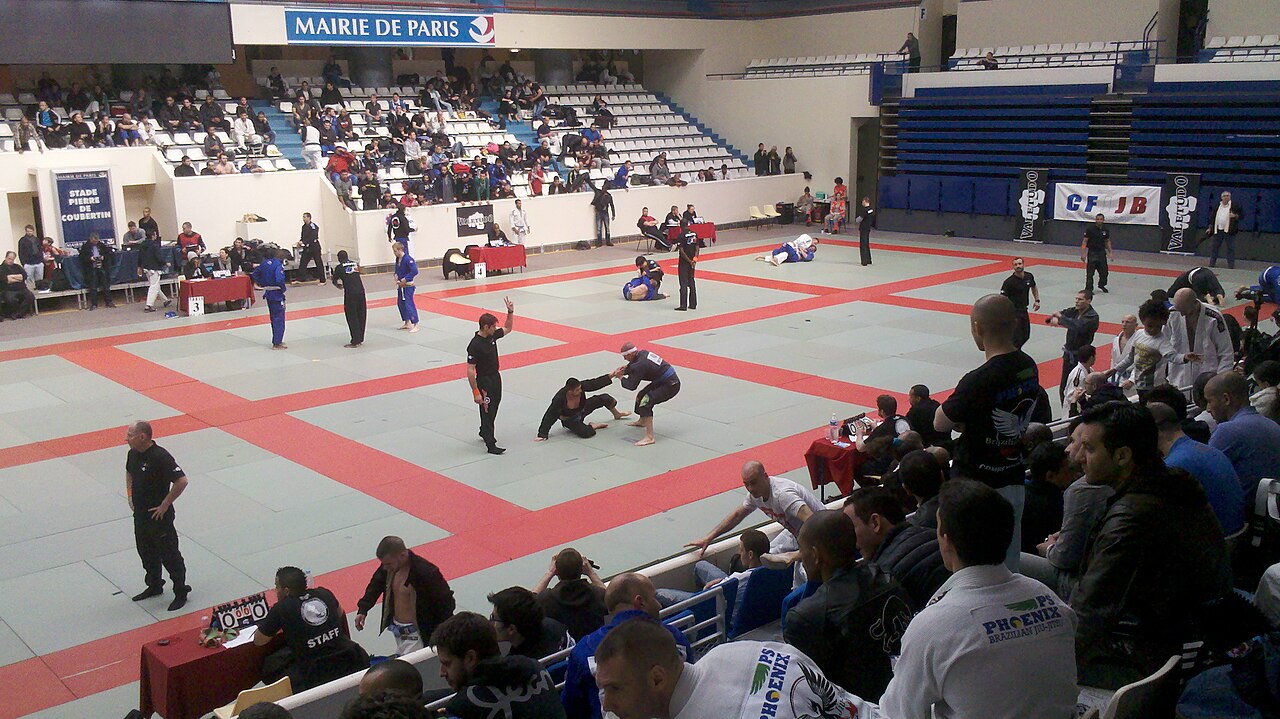
Does stepping onto the mat to compete change who you are? The honest answer from recent research: a match changes your body chemistry for a few hours, tests your focus and your nerves, and goes along with confidence, belonging and self-control. No study shows that it makes anyone a better man or a better woman. Only some of these studies are about jiu-jitsu, and we name the sport every time.
The short answer
- Brain chemistry: stress hormones rise before and during a match, and official matches raise them more than practice matches. These studies are small and mostly older.[13][14]
- Thinking: experienced jiu-jitsu athletes made more accurate but slower decisions in a small virtual reality test, and training with live problems sped up reactions.[2][6]
- Mind and character: organised sport is linked to higher self-esteem, better social skills and a stronger sense of belonging.[9][1]
- Body and risks: young grapplers are more flexible, but weight cutting and knee injuries are real costs.[10][3][5]
No experience, no equipment. We can lend a gi for the first 2 weeks.
What the studies found
We looked at 12 studies first published between January and March 2026, plus six older ones for the hormone questions. Studies that are not about competition, or not about jiu-jitsu, are marked.
| Study | Who | Sport | What they found |
|---|---|---|---|
| Jiang and others, 2026 | Older adults; review, no new data | Martial arts in general, not competition | Linked to brain-health markers, better executive function and emotion regulation, and less loneliness through social support [1] |
| Peric and others, 2026 | 10 men, average age 27 | Brazilian jiu-jitsu | Brown and black belts were more accurate but slower than blue and purple belts on virtual reality decisions. Preliminary [2] |
| Piekarski and others, 2026 | 303 adult and 455 masters brown and black belts at 2021 tournaments | Brazilian jiu-jitsu | Caution: with heel hooks legal, knee injuries were 26.5 per 1,000 matches for exposed competitors against 2.2 for the others [3] |
| Saulicz and others, 2026 | 88 women in competitive judo, 88 in other sports | Judo | Fewer and milder urinary symptoms in the judo group [4] |
| Park, 2026 | 414 elite Korean athletes, men and women analysed separately | Taekwondo, judo, wrestling, boxing | Caution: about 5.5% of body mass cut in about a week; fatigue, dizziness, irritability, poor concentration [5] |
| Giardullo and others, 2026 | 60 amateur and semi-professional athletes | Brazilian jiu-jitsu | Live-problem training: reaction times down 15% against 7%, and less distress. It compares teaching methods, not competition [6] |
| Müjdeci and others, 2026 | 454 athletes aged 12 to 18, 45 coaches, Türkiye | Boxing, judo, karate, kickboxing, taekwondo, wrestling | High scores on competence, confidence, connection and character. Contrary: higher-level competitors rated their own character lower, and girls reported less confidence than boys [7] |
| Özkan and others, 2026 | 30 inactive boys aged 12 to 15 (randomized) | Wrestling, non-competitive program | Six weeks improved well-being and resilience and lowered sport anxiety against a control group [8] |
| Wade and others, 2026 | 189 studies of children and teens aged 5 to 17 | Organised sport of all kinds | Higher self-esteem, fewer depression and anxiety symptoms, better social skills; weaker for individual sports than team sports [9] |
| Gerodimos and others, 2026 | 360 children and teens, Greece | Wrestling and taekwondo | More flexible than non-athletes, and girls more flexible than boys [10] |
| Meng and others, 2026 | 525 teenage boys, China | Boxing, sanda, taekwondo, wrestling, judo, kickboxing | Caution: more than half cut weight on purpose; 18% of those who cut showed eating-disorder symptoms on a screening questionnaire [11] |
| Fukushima and others, 2026 | 12,158 concussions in school clubs, Japan | School club sports; judo and karate named | Caution: judo had the second-highest concussion rate after rugby; 49% happened in competition, 44% in training [12] |
What Happens in Your Brain Chemistry Around a Match?
Your stress hormones rise before you compete, and that is normal. In an older study of 17 young male judo players, cortisol and anxiety were higher before an official contest than on rest days.[13] The players whose testosterone rose also showed more motivation to win and got better results.
Jiu-jitsu shows the same pattern. In 9 male jiu-jitsu athletes, official matches raised cortisol more than practice matches did.[14] Among 23 male judo athletes at an international event, those who finished in the top three had more cortisol and more worry in the morning, yet seemed to control their stress response better as the day went on.[16]
Across four simulated jiu-jitsu matches, adrenaline and noradrenaline responses tapered off while muscle-damage markers climbed.[15] A 2026 review also links martial arts in older adults to brain-health markers such as BDNF, a protein tied to neuroplasticity.[1] In at-risk youths, oxytocin stayed raised after the cool-down of one hard martial arts class, a training session rather than a match.[17] Keep the limits in mind: these are small groups of men, mostly older studies, and they describe a few hours, not a changed brain.
Does Competing Sharpen Your Thinking Under Pressure?
Possibly, but the evidence is thin and early. In a small study of 10 men, brown and black belts made more accurate decisions on virtual reality tasks than blue and purple belts, but they reacted more slowly.[2] The authors say the design cannot show that training caused the difference.
In a controlled study of 60 jiu-jitsu athletes, those taught with live problems cut their reaction time by 15%, against 7% for those taught the traditional way, and they felt less distress.[6] That compares two ways of teaching, not training against no training, and it did not measure a competition result.
A review of older adults also links martial arts to better executive function and emotion regulation.[1] In a smaller older trial, at-risk teenage boys who did six months of martial arts improved in self-control, mental switching and processing speed.[18] None of these studies tested a tournament itself.
Does Competing Help With Nerves and Resilience?
It brings the nerves, and the research suggests the mat helps people learn to handle them. Six weeks of supervised wrestling, with no competition, improved well-being and resilience and lowered sport anxiety in 30 previously inactive boys.[8] A review of 189 studies found organised sport linked to higher self-esteem and life satisfaction and fewer depression and anxiety symptoms in children and teens.[9]
Two honest limits apply. The wrestling trial had only boys and no follow-up, and the review mostly gathered observations that were self-reported, not martial-arts studies in particular.
The match-day studies above add one more idea: the judo athletes who placed best were nervous too, but they seemed to settle as the day went on.[16] Learning to do the work while nervous is a skill, and a tournament is one place to practise it. That last sentence is our coaching view, not a study result.
What Does a Match Ask of the Body?
A lot, and the body keeps the bill. Muscle-damage markers climbed across four simulated jiu-jitsu matches, so a long tournament day is not a light load.[15] On the positive side, young wrestlers and taekwondo athletes were generally more flexible than non-athletes, and girls were more flexible than boys.[10]
Women in competitive judo reported fewer and milder urinary symptoms than women in other sports.[4] That study relied on a questionnaire and does not say what the comparison sports were.
Does Competing Make You a Better Person, a Better Man or a Better Woman?
The studies cannot say that, but they do measure things that matter in a person: confidence, social skills, support and belonging. The review of 189 studies found better social skills, helping behaviour and belonging in young people who play organised sport, though individual sports showed weaker results than team sports.[9] The older-adult review describes martial arts clubs as a source of social support that reduces loneliness.[1]
The picture is not all positive. Among teenage combat-sport athletes, higher-level competitors felt more competent but rated their own character lower, and girls reported less confidence than boys.[7] In at-risk teenage boys, a stronger oxytocin response to training predicted less aggression later.[18] Results on aggression are mixed overall and depend on the club, as our kids research essay explains.
Nothing here points to one gender gaining more than another. What it shows is that men and women, girls and boys, are worth studying separately, and that a good coach notices who is struggling with confidence.
What Competition Does Not Do, and the Risks
It does not prove anyone better, and it carries real costs. Most of the studies above are observations or self-reports, so they show links, not causes. Several are small, and only five are about jiu-jitsu itself.
- Weight cutting: elite combat athletes cut about 5.5% of body mass in about a week and reported fatigue, dizziness, irritability and poor concentration.[5] In a teenage sample, more than half cut weight on purpose, and 18% of those who cut showed eating-disorder symptoms on a screening questionnaire.[11]
- Knee injuries: when heel hooks were legal in 2021, exposed brown and black belts had a much higher knee injury rate, though the confidence interval is very wide.[3]
- Head impacts: in Japanese school clubs, judo had the second-highest concussion rate. Rates are per club member, judo throws differ from jiu-jitsu rules, and the data end in 2020.[12]
These risks are a reason to choose a club with a clear plan for weight, injuries and recovery, not a reason to avoid the mat.
Try it before you decide
Competing is optional. Your first class is free, and you set the pace.
Book a free trialRead Next
- What competition does for children, age group by age group
- Competing as an adult: mind and body, men and women
- Martial arts and kids' confidence: what 12 studies show
- Jiu-jitsu for adults: fitness, stress and confidence
- Your first jiu-jitsu competition: a guide for families
- Kids competition guide and adults competition guide
- Upcoming competitions near Laval, updated every morning
When Are Classes?
| Group | Ages | Weekdays | Saturday |
|---|---|---|---|
| Apprentice | 3 to 4 | Mon, Tue, Wed 5:00 PM | 8:30 AM |
| Junior | 5 to 8 | Mon, Tue, Wed 5:30 PM | 9:00 AM |
| Teens | 9 to 13 | Mon to Thu 6:30 PM | 10:00 AM |
| Adults | 14 and up | Mon to Thu 7:15 PM | 10:45 AM |
Classes are taught in French and English. We can lend you a gi for the first 2 weeks, so you can try a few classes before buying one.
Ready to join? Register online in a few minutes.
References
We kept the results that do not go our way. Each link opens the study's official summary in its journal or in PubMed. The first 12 were published between January and March 2026; the last six are older background for the hormone questions.
- Jiang Y, Li P, Yang Y, et al. (2026). Neural mechanisms and social support for mental health in old age by martial arts exercise. Frontiers in Psychology 16:1733310. https://doi.org/10.3389/fpsyg.2025.1733310
- Peric T, Novicichin S, Rydzik L, et al. (2026). Cognitive functions and skill level in Brazilian Jiu-Jitsu: an exploratory study using virtual reality. Frontiers in Sports and Active Living 7:1738534. https://doi.org/10.3389/fspor.2025.1738534
- Piekarski M, Kreiswirth E, Barber Foss K, Jimenez ML, Myer GD, Montalvo AM (2026). Knee Injury in Competitive Brazilian Jiu Jitsu Athletes: Implications for Training. Sports Health 18(4):890-897. https://doi.org/10.1177/19417381251400303
- Saulicz A, Saulicz M, Saulicz E (2026). Assessing Lower Urinary Tract Symptoms in Women Practising Competitive Judo: Findings from a Cross-sectional Study. International Urogynecology Journal 37(6):1699-1707. https://doi.org/10.1007/s00192-026-06523-9
- Park KJ (2026). Sport- and sex-specific differences in rapid weight loss practices among elite combat sport athletes. Journal of Sports Medicine and Physical Fitness 66(7):838-846. https://doi.org/10.23736/s0022-4707.26.17620-8
- Giardullo G, Ceruso R, Di Lascio G, Taleb M, Esposito G, D'Elia F (2026). Comparison of traditional and ecological dynamical training approaches in Brazilian Jiu-Jitsu: effects on Force Development, reactivity, and distress perception. Frontiers in Psychology 17:1794709. https://doi.org/10.3389/fpsyg.2026.1794709
- Müjdeci I, Kılıç K, Bulut A, Kuru H (2026). Coaching effectiveness in competitive youth contact sports and martial arts: athletes' and coaches' perceptions. Frontiers in Psychology 16. https://doi.org/10.3389/fpsyg.2025.1725858
- Özkan R, Yılmaz C, Uzun RN, et al. (2026). Effects of wrestling training on psychological well-being, anxiety, and resilience in adolescent boys. BMC Psychology 14(1). https://doi.org/10.1186/s40359-026-03962-3
- Wade L, Eime R, Pankowiak A, et al. (2026). The impact of sports participation on psychological health and social outcomes in children and adolescents: a systematic review and update to the "Mental Health through Sport" conceptual model. Systematic Reviews 15(1). https://doi.org/10.1186/s13643-026-03104-1
- Gerodimos V, Tsiakaras N, Karatrantou K (2026). Flexibility in wrestlers, taekwondoists, and non-athletes during the developmental ages: the effects of sport, age, and sex. Journal of Functional Morphology and Kinesiology 11(1). https://doi.org/10.3390/jfmk11010057
- Meng F, Zhang Z, Xu K, Lvu M, Zhong Y (2026). Weight loss practices, perceptions, and eating disorder symptoms among Chinese male adolescent combat sports athletes. Frontiers in Nutrition 12. https://doi.org/10.3389/fnut.2025.1726260
- Fukushima K, Nakayama H, Tomori A, et al. (2026). Epidemiology of sport-related concussions among middle- and high-school students in Japan: a nationwide analysis using insurance registry data. BMJ Open Sport and Exercise Medicine 12(1). https://doi.org/10.1136/bmjsem-2025-002943
- Salvador A, Suay F, Gonzalez-Bono E, Serrano MA (2003). Anticipatory cortisol, testosterone and psychological responses to judo competition in young men. Psychoneuroendocrinology 28(3):364-375. https://doi.org/10.1016/s0306-4530(02)00028-8
- Moreira A, Franchini E, de Freitas CG, et al. (2012). Salivary cortisol and immunoglobulin A responses to simulated and official Jiu-Jitsu matches. Journal of Strength and Conditioning Research 26(8):2185-2191. https://doi.org/10.1519/jsc.0b013e31823b8702
- Andreato LV, Julio UF, Panissa VL, et al. (2015). Brazilian Jiu-Jitsu Simulated Competition Part I: Metabolic, Hormonal, Cellular Damage, and Heart Rate Responses. Journal of Strength and Conditioning Research 29(9):2538-2549. https://doi.org/10.1519/jsc.0000000000000918
- Papacosta E, Nassis GP, Gleeson M (2015). Salivary hormones and anxiety in winners and losers of an international judo competition. Journal of Sports Sciences 34(13):1281-1287. https://doi.org/10.1080/02640414.2015.1111521
- Harwood-Gross A, Feldman R, Zagoory-Sharon O, Rassovsky Y (2020). Hormonal reactivity during martial arts practice among high-risk youths. Psychoneuroendocrinology 121. https://doi.org/10.1016/j.psyneuen.2020.104806
- Harwood-Gross A, Lambez B, Feldman R, Zagoory-Sharon O, Rassovsky Y (2021). The effect of martial arts training on cognitive and psychological functions in at-risk youths. Frontiers in Pediatrics 9. https://doi.org/10.3389/fped.2021.707047